
Dr Cassandra Smith: Connecting researchers, communities and women’s cardiovascular health

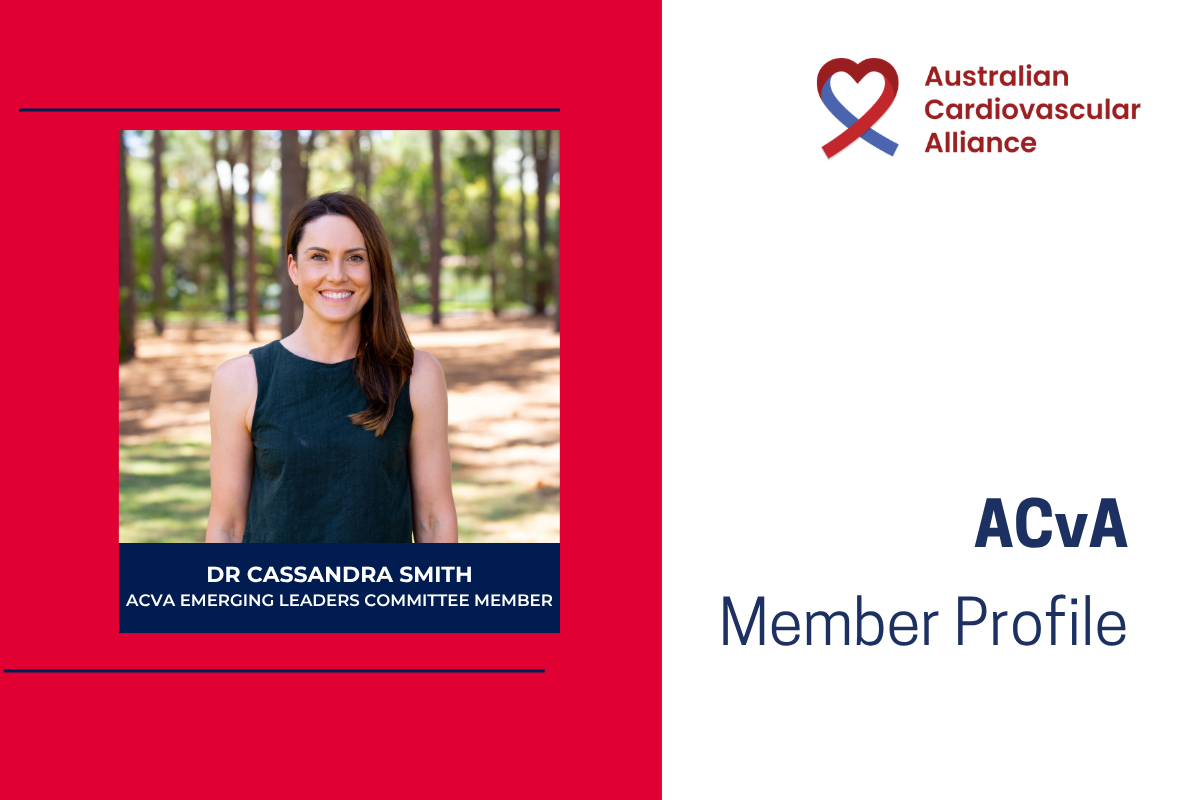
Vice Chancellor’s Research Fellow and Heart Foundation Postdoctoral Fellow alumna, Dr Cassandra Smith is an Accredited Exercise Physiologist who joined the ACvA Emerging Leaders Committee (ELC) to connect with researchers across Australia and share her expertise in consumer and community engagement.
Based at Edith Cowan University’s Nutrition and Health Innovation Research Institute, Dr Smith describes herself as a “clinician researcher” who is passionate about working with consumers and the community to improve women’s heart health.
Her interest in women’s cardiovascular health and exercise started early, making exercise physiology a natural fit. “As a young girl, my mindset was very simplistic, I believed I could fix everything through exercise until I became an exercise physiologist and realised that there’s a lot more to it than just asking people to exercise,” she says.
Growing up in Bairnsdale in regional Victoria, Dr Smith also saw within her own family how a lack of health literacy can affect the management of health conditions. “People can have a fear of the health systems, the medical interventions and medication even though they can be lifesaving,” she says.
These experiences have shaped her research, particularly her work with post-menopausal women, who may be more aware of their risks of breast cancer and even to some extent osteoporosis, but less aware of their cardiovascular disease (CVD) risk. “A lot of my work is around better understanding, screening and management for CVD in women,” she says. “We know that a sex disparity in CVD still persists, and I want to bridge this gap. We still have long way to go in understanding how CVD develops and progresses in women compared to men, and overcoming the education gap and systemic health system biases that drive this disparity.”
While having a young family means she is not currently practising clinically, Dr Smith still values the personal interactions that come through clinical trials and her community outreach activities. She gives community talks and works with a consumer advisory group, ensuring the people her research is intended to help are part of the process. “I think it’s very important that you’re creating solutions with the community, for the community,” she says.
This focus on connection also drew her to the ELC. Based in Western Australia, Dr Smith understands the challenges of connecting with researchers and initiatives across the country. “It’s not easy for us to travel between major cities and get involved in a lot of these initiatives,” she says. “I’m very passionate about bridging that gap and keeping researchers active without the restriction of borders.”
She is also keen to share her experience in consumer and community engagement with other emerging researchers, particularly as these skills become increasingly important to research funding. “It would be great to help researchers develop the skills to do the consumer and community engagement which should be a part of all our research,” she says.
Dr Smith is also passionate about supporting women in research. Having experienced career disruption while raising a young family and building her career as an early career researcher, she hopes to help develop initiatives that make it easier for women to stay connected, attend conferences and continue developing their skills during periods of change.
Bringing people together across disciplines, locations and areas of expertise is one of the things she values most about the ELC and ACvA. “It’s a great way to leverage a nationwide skillset,” she says, and she hopes to contribute her own experience while helping other emerging researchers build theirs.
At the same time, being part of the ELC has broadened her own perspective. “It’s a great opportunity to extend my abilities and understand the landscape through the lens of all CVD researchers.” For Dr Smith, that exchange of knowledge and experience is an important part of building a stronger, more connected cardiovascular research community.